Two Snohomish listings can carry nearly the same asking price this month and still describe two completely different transactions. One sits on First Street, in a craftsman that hasn't changed hands in years, where a showing schedule fills before the sign goes in the yard. The other sits off Bickford Avenue, a few doors from a townhome community that is still selling its last units, competing for buyers against the construction crews of a national developer building hundreds more homes next door. Quote either one as "the Snohomish median" and you've told a buyer almost nothing about what they're actually walking into.
That's the problem with treating Snohomish as one housing market. It isn't. It's three, and they are moving in different directions at the same time.
What one number is actually averaging
Snohomish breaks into three distinct segments that price on entirely different logic.
The historic downtown core, anchored by First Street, holds a fixed stock of Victorian and craftsman homes built roughly between 1880 and 1930. Nobody is adding to that supply. The valley acreage belt, spreading across the hills and floodplain east and south of town, is hobby farms, equestrian parcels, and view lots that price on land, water rights, and outbuildings rather than square footage comps, and draws a buyer pool that searches regionally instead of by zip code. Then there's what you might call conventional Snohomish, the newer subdivisions and multifamily product going up along the Bickford Avenue corridor, which competes directly with Lake Stevens and Monroe for the same trade-up family buyer and is where most of the city's actual transaction volume happens.
A single median folds all three into one number. Here's what that number hides.
| Segment | What drives price | Buyer pool | Supply trend |
|---|---|---|---|
| Historic downtown core | Scarcity, condition, restoration quality | Committed local and regional buyers | Fixed, can't expand |
| Acreage belt | Land, water, outbuildings, usability | Thin, regional, specialized | Fixed, rarely lists |
| Bickford corridor | New construction, amenities, commute | Trade-up families, first-time buyers | Actively expanding |
The historic core doesn't play by the same rules
Downtown Snohomish markets itself as the Antique Capital of the Northwest, and the branding isn't just tourism copy. First Street's commercial buildings date to the river-trade era, and the surrounding blocks hold a density of intact Victorian and craftsman homes that no builder today could reproduce at any price. That's a real constraint on supply, not a marketing angle.
The Historic Downtown Snohomish Association's 2026 annual report gives a sense of how much demand is pressing against that fixed stock. Downtown drew more than 100,000 additional visits in 2025 compared with the year before, and Kla Ha Ya Days alone generated over $150,000 for downtown businesses. That kind of foot traffic and event revenue keeps the district's identity, and its home values, resistant to whatever the broader county is doing on inventory. When a craftsman on First Street or one of the surrounding blocks does list, it draws a level of competition the rest of the city doesn't see, because there's no version of "we'll just build more of these."
Where the actual growth is happening
The Bickford Avenue corridor is the opposite story. It's where Snohomish is adding housing fast enough that the story is about absorption, not scarcity.
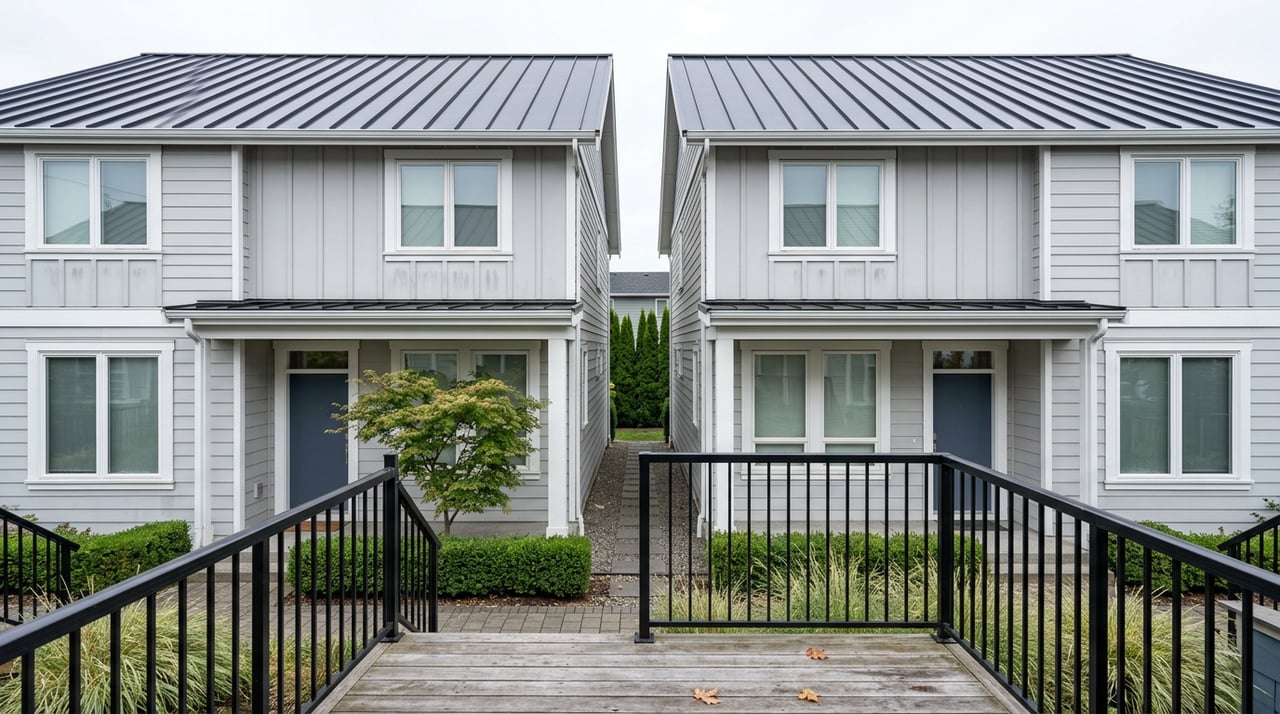
Bickford Landing, a townhome community at 2501 Bickford Avenue, has been selling into a still-active pipeline of new units, with several already sold and more finished, under construction, or coming soon as of this year. It sits walking distance from Home Depot, Fred Meyer, Kohl's, and a handful of chain restaurants, and within a few minutes of Cascade View Elementary, Centennial Middle School, and Snohomish High School.
That's a modest project compared to what's coming next door. Quarterra, a national developer based in Charlotte, filed applications this year for a project called Emblem Snohomish at 2502-2540 Bickford Avenue, spanning 17.3 acres and planned for seven apartment buildings totaling 294 units, a separate row of five townhomes, and roughly 10,000 square feet of commercial space including a coffee and doughnut shop with a drive-through. The project would replace five existing single-family homes and a shop, with a creek crossing separating the apartment portion from the townhome segment. As of mid-2026 the proposal remains in city staff review, with no construction start confirmed and ownership of the parcels not yet finalized, so treat it as a signal of where capital is pointed rather than inventory you can walk through today.
A third project on the same corridor tells you why developers keep choosing this stretch of road over anywhere else in town. DXD Capital is building a 108,000-square-foot, three-story self-storage facility at Bickford and Weaver, partnering with Extra Space Storage to operate it, and the company has pointed to rising incomes among Snohomish households moving into multifamily housing as part of its reasoning for the site. A regional vacancy figure backs up why national capital keeps circling this specific corridor: Snohomish County posted the lowest multifamily vacancy rate of any submarket in the Puget Sound region in the first quarter of 2026, at 6.1 percent, according to Kidder Mathews data. Developers aren't guessing. They're following a vacancy number that says this corridor can absorb supply that other parts of the region can't.
The number that doesn't add up
Here's where the median gets genuinely confusing if you don't know which segment you're looking at.
Over the three months ending May 2026, the median sale price inside Snohomish city limits was $750,000, up 6.7 percent from the same period a year earlier, with the average price per square foot at $424, up 7.5 percent. Homes were going pending in about seven days with two offers on average. On paper, that reads like a market getting hotter.
But only 38 homes sold in Snohomish in May 2026, down from 58 in May 2025, a drop of roughly a third in transaction volume even as the median climbed. Fewer sales, higher median: that combination usually means the mix of what's closing has shifted, not that every home in town gained value at the same rate.
Zoom out to the countywide figure and the direction flips. Snohomish County's median sale price in July 2026 was $746,000, down from $799,000 in July 2025. Active listings across the county rose about 37 percent year over year to 2,246 homes, and months of supply climbed from 2.1 to 3.0. Homes still sold quickly, averaging 29 days on market and fetching about 99 percent of their final list price, but the trend line points toward more buyer leverage, not less.
Put the two together and a pattern emerges. The city-level median is being pulled up by a shrinking number of higher-value transactions closing in segments that can't add supply, the historic core and the acreage belt, while the county-level number is absorbing the wave of new, moderately priced product coming out of corridors like Bickford. Neither number is wrong. They're measuring different things, and a buyer who only sees the headline city median has no way to know that.
What this actually means depending on why you're here
If you're drawn to First Street or the surrounding historic blocks, the fixed supply means you should be ready to move the moment something lists, financing lined up in advance, because the visitor traffic and event revenue downtown is pulling in tells you the appeal isn't fading.
If you're shopping the acreage belt, remember the buyer pool is thin and regional, and pricing works off land, water, and outbuildings rather than a standard comp set. Worth checking address by address too: the Snohomish School District boundary extends well past city limits into the acreage belt, so a rural property that looks like it's in a different district might not be.
If you're looking at the Bickford corridor, you're in the one segment where the county's softer numbers actually apply. Supply is expanding in real time, from Bickford Landing's remaining units to the hundreds more that Emblem Snohomish would eventually add, and that's where a buyer today has the most room to negotiate.
A few questions worth answering directly
Does the citywide median include the acreage belt? Yes, when using MLS-wide figures for Snohomish, acreage and historic-core sales get folded in with everything else. That's precisely why the number moves in ways that don't match what a specific property type is doing.
If I want a home in the historic district, do the county's easing numbers apply to me? Not really. Fixed-supply segments don't loosen just because county-wide inventory is rising elsewhere. The historic core answers to its own scarcity, not to the broader inventory count.
Is the Emblem Snohomish project a reason to wait? It's a reason to watch, not to wait. The proposal is still working through city review as of mid-2026, with no confirmed construction timeline, so it's a signal about where future supply is headed rather than something changing today's market.
Snohomish rewards buyers and sellers who know which of these three markets they're actually in before they start comparing prices. If you're trying to figure out where your budget lands, whether that's a First Street restoration, acreage with room to spread out, or a newer build off Bickford, Jenell Steltz can walk you through the comps that actually apply to your situation. Request your free home valuation and seller strategy to get a read on your specific corner of Snohomish, not just the headline number.